How to Help an Overstimulated Dog When Guests Enter the Home
- Carlos C.

- Feb 18
- 4 min read
Updated: 3 days ago
When the front door opens, many dogs lose control..
They bark.
They jump.
They spin.
Sometimes they even bite..
Regardless of what they do, the fact is they struggle to regulate their emotions in that moment.
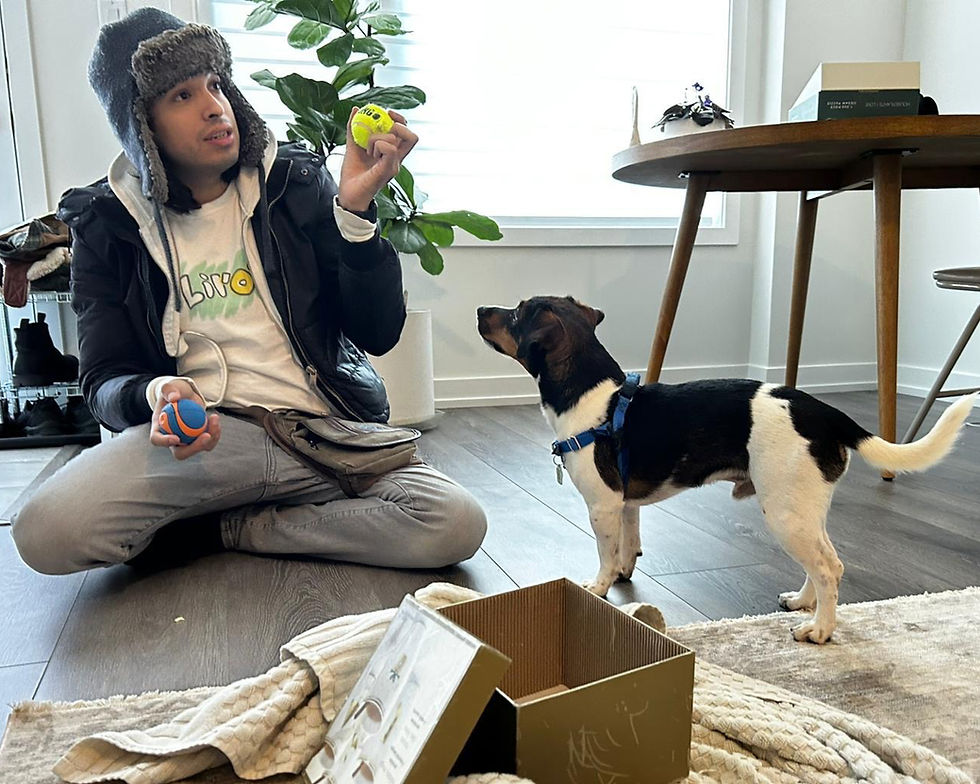
Recently, during a private session in Mississauga, I worked with a sweet but nervous and unsure 4 year-old dog named Doug, who experiences exactly overstimulation when someone walks through the front door.
Below is what we focused on, and why it matters for any dog who becomes overstimulated or reactive when guests arrive.

Safety Comes First
Before we started, I replaced Doug’s harness with one from 2HoundsDesign that I brought with me.
The harness he was wearing did not fit properly, given the situation where Doug is feeling the need to lunge, jump and have me go away.
And as much as I want to respect his wishes and give him all the space and time he needs, I'm there to help and (spoiler alert) I always promise that a dog will leave the session feeling better than it started!
That said, in moments of high excitement or emotional overload, an ill-fitting harness can become unreliable for all involved. A dog who is twisting, pulling, or scrambling can slip out and cause further issues. The harness I brought with me was not meant to train Doug, simply provide more comfort and safety to an otherwise uncertain situation.
Please know that even the most reliable equipment will not address a dog's feelings and behaviour. It simply creates stability so that learning can happen safely and carefully.
Understanding the Real Problem
Doug struggles with overstimulation and overexcitement when someone enters through the front door, as many dogs do. This is very common because the front door brings:
sudden movement
anticipation
emotional buildup
repeated history of high-arousal behaviour
Doug has practiced reacting this way for months and years, through no fault of his own or his pet parents. He simply repeats it because, from his perspective, it works. The behaviour helps him manage how he feels, and it will continue to until we show him different ways of regulating his emotions.
Our goal during our session was not to make Doug instantly comfortable. That is unrealistic. Our goal was to help him regulate a discover a different way of feeling in overwhelming moments.

Exercise One: Walk and Praise
The first exercise is simple. Doug’s pet parents walked him indoors on a loose leash while I stayed at a comfortable distance. Walking is one of the most natural ways dogs (and many animals) regulate their emotions by creating space and thus not escalating a situation.
Animals in the wild learn that they can move away from difficult scenarios from experience and others around them. But many dogs however, have never practiced that skill at home. While some are simply far too overwhelmed in their home environment to think clearly enough to walk away.
By guiding Doug gently indoors with zero leash pressure or tension and calmly praising him, we showed him something important:
He can walk away.
He does not have to escalate.
He has options.
That awareness alone can begin to change how a dog experiences the front door and other stressful situations.
Exercise Two: Structured Play
The second exercise involved playful, agility-like games in the living room. Doug moved from one surface to another, jumping on and off as guided by his pet parents. This was not random excitement. It was structured play.
Instead of focusing on me (the guest), Doug instead focused on the game, more easily the more they kept at it. Instead of building tension, he used his energy in a controlled and collaborative way. For Doug, this created the clearest emotional shift. Not because he suddenly loved having a guest in the home, but because he had something else to engage with and feel better through.

What This Does Not Do
Walking and play will not instantly turn an overstimulated dog into a perfectly calm one. That is impossible to expect. Especially when:
the situation has history
the reaction has been repeated for months or years
the behaviour has felt successful to the dog
Emotional change takes time, safety and consistency. Helping a dog walk away or redirect through play is just the beginning of teaching regulation.
The Final Part of the Session
In the final part of the session, Doug became loose enough to finally be his silly self (which is who he really is deep down) with me, thanks to the guidance of his pet parents. Yet even then, in a positively exciting moment, I asked his pet parents to guide Doug away with them, just to continue reinforcing that walking away is an option.
Whether a dog is feeling unsure or excited, they should always know they can take space and regulate. Walking away is not avoidance, it's a life skill.
Why This Approach Works
When a dog becomes overstimulated at the front door, the goal is not to suppress the behaviour. The priority and goal needs to always be:
to reduce emotional overload
to provide an alternative action
to build regulation skills over time
to prevent repeated rehearsal of explosive reactions
Dogs who learn they have options feel less trapped. And dogs who feel less trapped react less intensely.
If your dog struggles with overstimulation when guests enter your home, remember:
Regulation comes before listening skills.
Safety comes before training.
And all of the above requires ongoing practice.